Apiculture has been practiced in Kenya since the migrations of current communities into Kenya. Indigenous communities, such as the Okiek, who are hunters and gatherers might have handled bees as early as 2000BC. By far, beekeeping has remained traditional with honey the major commodity being harvested from log hives and the wild. However, the 1960s saw a slight increase in modern beekeeping and especially with regards to beehives. Kenya also pioneered the early stages of a modernized beekeeping through the development of the Kenya Top Bar hive.

Despite this largely traditional outlook on beekeeping, Kenya produces about 100,000 metric tons of honey annually. This is, however, an insignificant amount at just about 20 per cent of its potential. Kenya has great potential in beekeeping as 80 per cent of the land mass is classified as arid and semi-arid. These regions have an abundance of flora, such as acacia trees, and other factors capable of supporting a bee industry all year round.

With such a wonderful resume, one wonders why little has been done to exploit the potential of a modern beekeeping industry. There is little conversation in beekeeping happening in Kenya with government institutions, such as the Beekeeping Training Institute remaining dormant. The lack of modern systems that brings beekeepers together through association is another hindrance to the development of beekeeping. There is also an increase in the loss of bee biodiversity. More lands are being cleared for crop production and other unsustainable activities, such as charcoal burning. These, together with the use of pesticides, remain the major risks facing colonies in Kenya.
The Happy Community Organization that I founded is looking to address this challenges and establish beekeeping as a platform for addressing more challenges. For bee colony success to be achieved, biodiversity protection is critical. Communities must be made to understand that not all lands are suitable for crop production. They must adopt appropriate land use. To this end, most land in Kenya are naturally suitable for beekeeping. There is need to reclaim more lost lands by increasing flora to support beekeeping. Beekeeping has the potential to be a catalyst to environmental conservation, such as forests. This is through integrated agriculture that allows communities to practice modern beekeeping around forests. With time, communities would appreciate the value of forests while making decent incomes. On the other hand, the bees would be supporting the ecosystem balance through pollination.
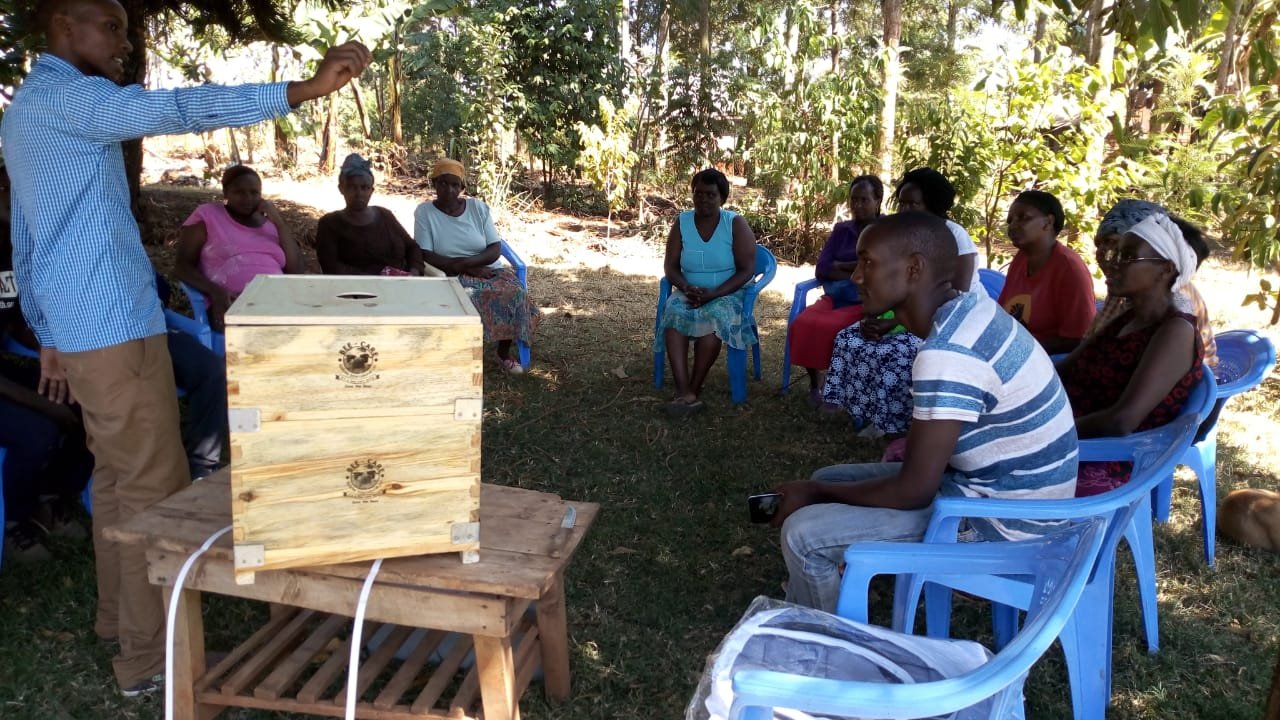
In the dry regions of Kenya faced with high levels of poverty, some beyond the national average of 36 per cent. These regions can limp through the long trains of poverty through the development of commercial beekeeping. We champion beekeeping in these regions as a climate resilient economic activity. Regions such as Baringo, Makueni, Kitui, Kajiado among others have great potential. More training is required to educate communities on beekeeping. Equally, there is need for partnership to assist the development of this industry within communities. This is especially with regard to helping communities acquire modern tools and equipment, such as beehives and community processing plants, to enable the commercialization of beekeeping in Kenya. This is the other reason for the formation of Happy Community Organization. To help communities look for partners that will help them develop beekeeping and build capacity of beekeepers in Kenya.
To establish a modern commercial beekeeping industry in Kenya that is focused on poverty eradication, biodiversity conservation and bee research is something that will require a great partnership by all major players in the industry. Institutions, such as the Bee Keeping Institute and Baraka College, must be more community oriented. The success of any beekeeping industry will be achieved through the involvement of communities and biodiversity conservation. The feeling today is that communities have been left behind, making it hard to make progress. Global institutions, such as Apimondia, could also help through forwarding materials and partnerships to assist with the development of best international standards of beekeeping in Kenya.
James Njuguna Wangunyu is the founder of the Happy Community Organization, a non-profit organization focused on developing a modern bee industry in Kenya to help in poverty eradication and biodiversity conservation as part of its contributions to the Sustainable Development Goals
Follow James on Twitter